
Alliance & Betrayal
| Players | Even Match |
| Infiltrators | Not Allowed |
| Battle Length | 5 Turns |
Several Warbands converge on the same battlefield. Alliances are quickly formed and then broken as the Warbands try to dominate the heart of the battlefield.
Forces
No special restrictions apply to the models the players can include in their Forces in this scenario.
Multiplayer Scenario:
Alliance & Betrayal is a multiplayer scenario that can be played by three or four players.
The Battlefield
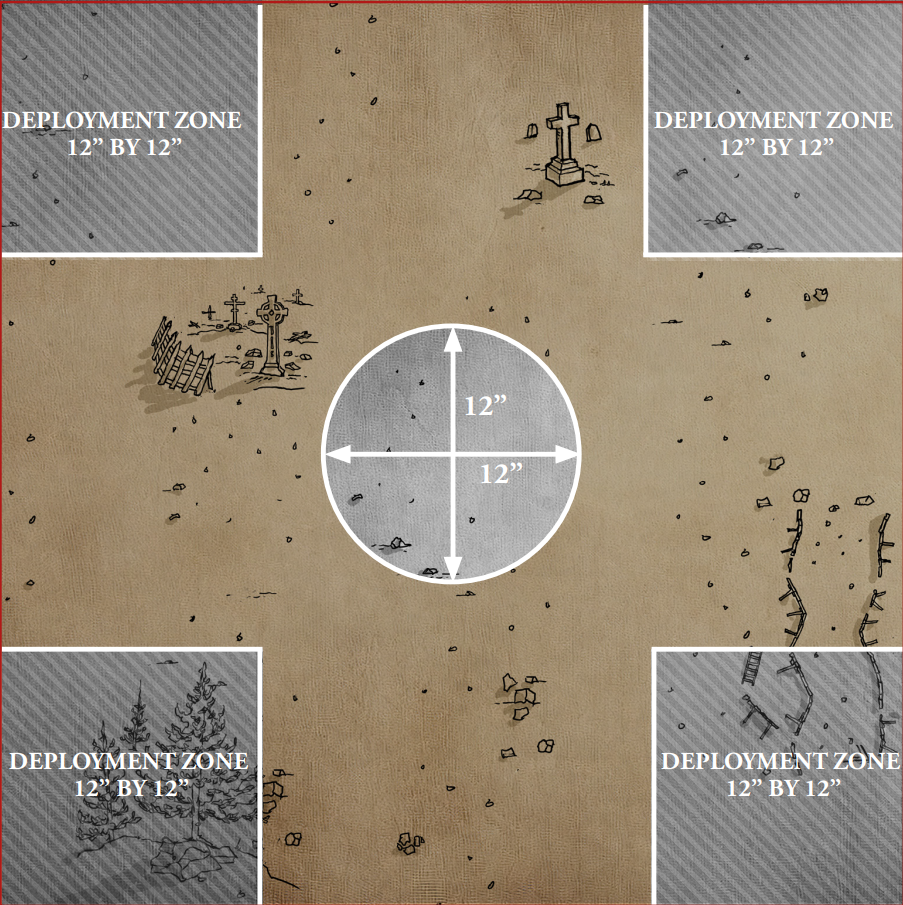
The players make a draw, and the winner sets up the terrain for the game. This scenario uses the Decimated Ruins battlefield archetype and requires a battlefield that is 48” by 48”. Impassable terrain cannot be set up within 6” of the centre of the battlefield.
Deployment
The players make a draw. The winner of the draw chooses which Deployment Zone will be theirs and places the Ace they were given face-up beside it so that everyone knows the player's card suit. They then deploy their Warband so that all the models are wholly within the Deployment Zone. Then the player who came second chooses a Deployment Zone, reveals their card suit and deploys their Warband, and so on. When all the players have deployed, the first Turn of the game can start.
Infiltrators
Infiltrators must deploy normally (they cannot use their special deployment rules).
Game Length
This scenario lasts five Turns.
Victory Conditions
A player wins this scenario immediately if all the opposing Warbands have fled (typically due to failing a Morale Check). Otherwise, the player with the most Victory Points at the end of the game is the winner.
At the end of each Turn, each player scores:
- 1 VP if they are in a joint alliance (see Alliance Period).
- 1 VP for each attack made by a friendly model that took an enemy model Out of Action
- 2 VPs if they have any models within 6” of the centre of the battlefield.
- 3 VPs if they have more models within 3” of the centre of the battlefield than any other players (in addition to the points for having any model within 6” of the centre of the battlefield).
At the end of the game, each player scores 1 VP for each Glorious Deed they completed.
Victory Point Bribes
In this scenario, players can give 1 or more of the Victory Points they have scored so far to another player. They can do this at any time and for any reason, but once the points have been transferred to another player, they do not have to be returned if the other player fails to deliver on any deals that have been made. Victory Points that are used as bribes in this way are removed from the player's score and added to the score of the player who they gave them to.
Card Decks
To play this scenario, you will need 2 decks of cards. Each deck will need to have a different-coloured back or be of a different shape or size so you can tell them apart. One of the decks is used when cards are used to make a draw or determine the Initiative, as described in the rules for Multiplayer Games. The other deck is called the Betrayal Deck.
At the start of the game, take the Aces from the Betrayal Deck, shuffle them, and give one to each player. This card shows the player's card suit. If you are playing a three-player game, discard the remaining Ace; it will not be used in this game.
Then take the remaining cards from the Betrayal Deck, shuffle them, and place them face down in easy reach of all of the players. If the Betryal Deck is exhausted, take any discarded Betryal cards apart form the aces, shuffle them together, and place them facedown to create a new deck.
Betrayal Cards
After the Initiative for the Turn has been determined, the players are allowed to draw Betrayal Cards. These cards allow a player to carry out nefarious coups and ruses during the game.
Betrayal Cards are drawn from the Betrayal Deck. Players can look at the cards they draw and are allowed to keep them secret from the other players. The number of cards each player draws depends on the number of Victory Points they have scored so far in the game:
- If they have more Victory Points than every other player, they get 1 card.
- If they have fewer Victory Points than every other player, they get 3 cards.
- Otherwise, they get 2 cards.
Players can get extra Betrayal Cards during a Turn in the following circumstances:
- A player gets 1 extra card at the end of the Alliance Period if they are not allied with any other players and no other players are allied with them (see the Alliance Period).
- A player gets 1 extra card if they roll a 2 or a 12 for a Success Roll before any modifiers or re-rolls are taken.
Using Betrayal Cards
Betrayal Cards can be used in one of two ways; either to carry out a coup or a ruse. Cards that a player holds that match their card suit are used to carry out a coup; other cards can be used to carry out a ruse.
To determine exactly what each card allows you to do, look it up on the Betrayal Cards Table that you can find at the end of this scenario. The table explains when you can use a card and what effect it has when it is used to either carry out a coup or a ruse.
Trading Cards
You can trade your Betrayal Cards with another player at any time. For example, you could swap a card with an opponent so that you each get a card that you want, or you could use them to bribe another player into forming an alliance, or you could give a card to another player to help the player with an attack they are making, and so on.
The Alliance Period
After any Betrayal Cards have been drawn, the players have a 3-minute period of play to create and form alliances. At the end of the 3-minute period, each player can secretly write down the name of one other Warband (you can use the Warband's card suit if you wish). You do not have to write down anything if you do not wish to.
Then, the names the players wrote down are all revealed simultaneously. A player who has written down a name is in an alliance with that Warband for the rest of the Turn. If two players allied with each other, then they are said to be in a ”joint alliance” for the rest of the Turn. Play then proceeds to the Betrayal Cards phase.
Alliance Effects
An alliance has the following effects:
- A player cannot choose a model from a Warband they are allied with as the target for an attack (even if the other Warband is not allied with them in return).
- Models that are from a Warband that are in a joint alliance can move within 1” of each other.
- Models that are in a joint alliance can treat models from the other Warband as friendly models when they use an Ability, Battlekit, or Skill.
- A player who is not in an alliance receives 1 extra Betrayal Card at the end of the Alliance Period (see Betrayal Cards).
- Each player in a joint alliance receives 1 Victory Point at the end of the Turn (see Victory Points).
Alignment (optional)
Before the game starts, the players can agree that alliances can only be formed between Warbands that have the same alignment. If even one player objects to this, or if the players forget to discuss alliances before the game has started, then alliances can be formed between any Warbands.
The Betrayal Table
Betrayal Cards have the following effects. Use the Coup column if the suit of the card matches the player's card suit. Otherwise, use the Ruse column.
| Card Value | Coup | Ruse |
|---|---|---|
| 2 | Counter: Play this card when a model is chosen as the target of a Melee Attack. The friendly model carries out the Attack instead of the enemy model. | Misdirection: Play this card when a model is chosen as the target of a Ranged Attack. You pick a new target for the Ranged Attack (the target cannot be from the attacking model's own Warband). |
| 3 | Power Play: Play this card when a player announces an alliance. They must pick you as their ally instead. | Tripwires: Play this card when a model is about to move. Its Movement Characteristic is halved for the move. |
| 4 | Coup de Grâce: Play this card before a model takes a Melee Attack on a model that is down and has 3 or more Blood Markers . The target is taken Out of Action (do not take a Success Roll for the attack). | Revenge: Play this card after a friendly model is taken Out of Action by an enemy attack. The attacking model becomes a prime target for all of your models. Add +2 Dice to the Success Rolls for attacks that target that model until the end of the Turn. |
| 5 | Sabotuer: Play this card when an enemy model is about to move. Its Movement Characteristic is halved for the move. | Bad Luck: Play this card before a player takes a Success Roll or a Risky Success Roll. Add -1 Dice to the roll. |
| 6 | Oh No You Don't: Play this card before a model takes a Retreat Action . The Action is cancelled and the enemy model's Activation ends | Valuable Lives: Play this card at the end of a Turn. For every friendly model taken Out of Action on that Turn, your warband gains 10 Ducats. |
| 7 | Hesitation: Play this card when a model takes a Charge Action . The Action is cancelled and the enemy model's Activation ends | Malediction: Play this card before you make an Injury Roll for an enemy model. Add +2 Injury Dice to the roll. |
| 8 | Double-Cross: Play this card at any time if you are in an alliance. You are no longer allied with the player you wrote down. | Bribe: Play this card at any time to give another player 1 Victory Point. |
| 9 | Triple-Cross: Play this card at any time if you are in an alliance. You are no longer allied with the player you wrote down. Then pick another player who is not in an alliance. You and that player are in a joint alliance for the rest of the Turn. | Bribe: Play this card at any time to give another player 1 Victory Point. |
| 10 | Con: Play this card at any time if you are in a joint alliance with a player who has 1 or more Victory Points. You steal 1 of their Victory Points and the alliance is broken. | Large Bribe: Play this card at any time to give another player 2 Victory Points. |
| Jack | Sure Thing: Play this card when a player takes a Success Roll or Risky Success Roll. Add +3 Dice to the roll. | Good Luck: Play this card when a player takes a Success Roll or Risky Success Roll. Add +1 Dice to the roll |
| Queen | Flee!: Play this card before a player takes a Morale Check. The Morale Check is failed (do not roll the dice). | Hold On!: Play this card after a player you are allied with fails a Morale Check. They can re-roll the Morale Check. |
| King | Greedy Bastard: Play this card at the end of a Turn if you are in a joint alliance. You get 2 Victory Points instead of 1 from this alliance, and the other player gets none. | Inglorious: Pick an enemy model. That model cannot complete any Glorious Deeds for the rest of the game |